
Autism Evaluation for Children: What Parents Need to Know
If you've found yourself Googling "does my child have autism," you're not alone. Many parents notice something feels different about their child's development long before anyone else does and that instinct matters.
Getting an autism evaluation can feel overwhelming, but it is one of the most important steps you can take for your child. The earlier a child receives a diagnosis, the sooner they can access the support that helps them thrive. This guide walks you through everything you need to know, from recognizing the early signs to understanding what the evaluation process actually looks like.
What Is an Autism Evaluation?
An autism evaluation is also called an autism assessment or ASD evaluation, which is a comprehensive process used to determine whether a child meets the criteria for Autism Spectrum Disorder (ASD). It is not a single test. It is a detailed review of your child's development, behavior, communication, and social skills, carried out by a qualified professional or a team of specialists.
A diagnosis can only be made by a licensed professional such as a developmental pediatrician, psychologist, or neuropsychologist. However, other providers including speech-language pathologists and occupational therapists often play an important supporting role in the evaluation process.
Signs Your Child May Need an Autism Evaluation
Every child develops differently, but there are certain milestones and behaviors that may warrant an evaluation. Talk to your child's pediatrician or seek an evaluation if you notice any of the following:
In toddlers and young children (under 3):
Not responding to their name by 12 months
Not pointing, waving, or using gestures by 12 months
No single words by 16 months or no two-word phrases by 24 months
Loss of previously acquired language or social skills at any age
Limited or no eye contact
Little interest in other children or in playing with others
Repetitive movements such as hand flapping, rocking, or spinning
Strong attachment to routines and distress when routines change
Unusual sensitivity to sounds, textures, lights, or tastes
In older children:
Difficulty understanding social cues or reading facial expressions
Challenges making or keeping friendships
Very focused interests in specific topics
Difficulty with back-and-forth conversation
Taking language very literally
If you are noticing several of these signs then trust your gut and seek an evaluation. You do not need to wait for your pediatrician to bring it up first.
When Should a Child Be Evaluated for Autism?
The American Academy of Pediatrics recommends that all children be screened for autism at their 18-month and 24-month well-child visits. However, a full diagnostic evaluation can and should happen as soon as concerns are identified but there is no minimum age.
Research consistently shows that early intervention, ideally before age 3 leads to significantly better outcomes for children with autism. Do not wait to see if your child "grows out of it." If something feels off, earlier is always better.
What Does the Autism Evaluation Process Look Like?
Every evaluation is a little different depending on the provider and your child's age, but here is what you can generally expect:
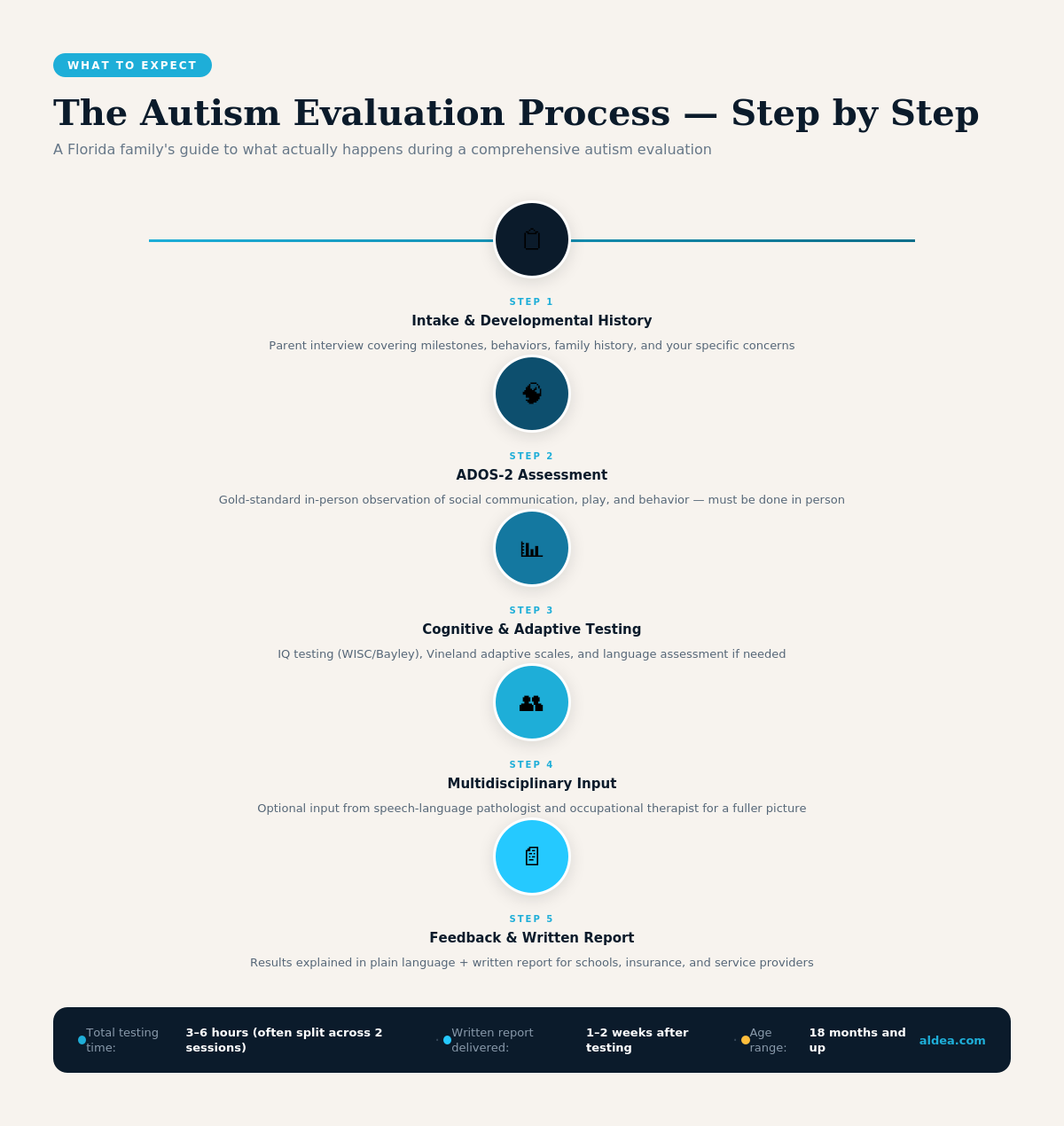
Step 1: Developmental and medical history The evaluator will ask you detailed questions about your child's development from birth such as milestones, medical history, family history, and your specific concerns. Your input as a parent is one of the most important parts of the evaluation.
Step 2: Standardized assessments The evaluator will use gold-standard tools to assess your child. The most commonly used is the ADOS-2 (Autism Diagnostic Observation Schedule), which involves structured play and interaction activities that allow the evaluator to observe your child's communication, social behavior, and play.
Step 3: Observation The evaluator will spend time directly observing and interacting with your child and watching how they communicate, play, and respond to social cues.
Step 4: Cognitive and developmental testing Depending on your child's age and the concerns identified, the evaluation may also include testing of language, cognitive abilities, and adaptive behavior skills.
Step 5: Feedback and report After the evaluation, the provider will meet with you to discuss the results and provide a written report. If your child receives a diagnosis, they will walk you through what it means and what next steps look like.
Who Can Diagnose Autism?
Autism can be diagnosed by:
Developmental pediatricians
Child psychologists or neuropsychologists
Child psychiatrists
Other providers such as speech-language pathologists and occupational therapists cannot diagnose autism on their own but often contribute important information to the evaluation and are key members of the care team after a diagnosis.
What Happens After an Autism Diagnosis?
A diagnosis is not an ending, it is a starting point. Once your child has a diagnosis, they become eligible for a range of supportive services including:
Applied Behavior Analysis (ABA) therapy - one of the most evidence-based interventions for autism, focusing on developing communication, social, and adaptive skills
Speech-language therapy - to support communication, language development, and social use of language
Occupational therapy - to support sensory processing, fine motor skills, and daily living skills
School-based services - children with an autism diagnosis may qualify for an IEP (Individualized Education Program) through their school district
The earlier these services begin, the better. Many families see meaningful progress within months of starting therapy.
How to Find an Autism Evaluation in Florida
One of the biggest challenges Florida families face is the waitlist. In many parts of the state, families wait 6 to 12 months or longer just to get an evaluation appointment.
Aldea was built to change that. We connect families across Florida to vetted pediatric providers with real, current availability so you can get answers sooner and start supporting your child without the wait.
You can search for autism evaluation providers in your area, verify your insurance, and book directly through the Aldea platform in English or Spanish.
Find an autism evaluation provider near you.
Frequently Asked Questions
Does my child have to have all the signs to be evaluated?
No. If you have any concerns about your child's development, an evaluation is always appropriate. You do not need a certain number of signs or a referral in most cases.
Will my insurance cover an autism evaluation?
Many commercial insurance plans cover autism evaluations. Coverage varies by plan. Aldea can help you find a provider that takes your insurance.
What if my child's pediatrician says to wait and see?
You have every right to seek an evaluation even if your pediatrician suggests waiting. Trust your instincts. An early evaluation even if the result is that your child does not have autism gives you valuable information.
Can autism be evaluated in Spanish?
Yes. Aldea connects families to bilingual providers who can conduct evaluations in both English and Spanish.
My child already receives speech therapy, do they still need a separate autism evaluation?
Yes. A speech-language pathologist can identify communication delays and provide therapy, but only a qualified diagnostician can make an autism diagnosis. If autism is suspected, a separate evaluation is needed.
How long does an autism evaluation take?
A comprehensive autism evaluation typically takes 3–6 hours and is often split across two appointments. This includes the parent interview, the ADOS-2 assessment, cognitive and developmental testing, and clinical observation. The written diagnostic report is usually delivered within 1–2 weeks after testing is complete.
What is the difference between an autism screening and an autism evaluation?
A screening is a brief checklist or questionnaire often done at a pediatrician visit that flags whether a child may need further assessment. It is not a diagnosis. An evaluation is a comprehensive in-depth assessment conducted by a licensed professional that can result in an actual diagnosis. If a screening raises concerns, the next step is always a full evaluation.
What if my child gets evaluated and the result is that they do not have autism?
A negative result is not a wasted evaluation. It rules out autism and points your family toward other possible explanations for what you are observing such as ADHD, a speech delay, a sensory processing difference, or anxiety. An evaluation always gives you more information than you had before, regardless of the outcome.