
My 2-Year-Old Isn't Talking but Understands Everything, Should I Be Concerned?
By Michelle McGuinness, M.A., CCC-SLP | Aldea Medically reviewed by Sharonda Oppong Addae
Direct Answer
A 2 year old who understands language well but isn't talking much most likely has an expressive language delay, a gap between how much a child comprehends and how much they produce. By age 2, most children use at least 50 words and begin combining two words together, such as "more juice" or "daddy go." Strong comprehension is a positive sign, but it does not guarantee speech will develop on its own. A child with fewer than 50 words, no word combinations, or vocabulary that has stopped growing warrants a speech language evaluation. What parents often don't know is that the profile, how strong comprehension is, whether gestures are present, and how quickly vocabulary is moving, determines exactly what kind of support helps most. A speech language pathologist can assess that profile in a single session and tell you precisely where your child stands. Aldea connects families with licensed SLPs who specialize in toddler language delays and can see your child quickly, often faster than a hospital waitlist.
Key Takeaways
Speech delay means development is behind expected milestones for age; normal variation means development is slower but still moving forward
The single most important differentiator is progress over time, not a word count on a single day
By 24 months, most children use 50 or more words and begin combining two words; by 36 months, they use 200+ words and three to four word sentences
Strong receptive language (understanding) is a positive sign but does not rule out an expressive language delay that benefits from support
Any regression, loss of words or social skills previously demonstrated, is not normal variation at any age and warrants immediate evaluation
Most speech and language delays are identified and addressed most effectively between 18 and 36 months, the highest impact window for early intervention
Early Intervention services are available at no cost for children under 3 and do not require a physician referral
Early evaluation provides clarity and direction; it does not automatically mean a diagnosis, therapy, or a label
If your pediatrician says to wait and see but you remain concerned, you have the right to seek an independent evaluation
Learn More -> What Are The First Signs of Speech Delays
What Does It Mean When a Toddler Understands Everything but Isn't Talking?
When a toddler understands language well but produces significantly fewer words than expected, it points to a difference between two distinct language systems:
Receptive language is the language a child understands, the words they recognize, the directions they follow, and the questions they respond to. Receptive language is processed internally and does not require the child to produce any output to demonstrate it.
Expressive language is the language a child produces, the words they say, the phrases they combine, and the sentences they build. Expressive language requires the child to retrieve words, plan speech movements, and produce them in real time.
These two systems are related and typically develop in parallel, but they can diverge. In young children, receptive language almost always develops ahead of expressive language to some degree. The question is whether the gap between the two is within the range of typical variation or has grown large enough to suggest that expressive language needs support.
A 2 year old who clearly understands multi step directions, identifies objects and pictures accurately, responds appropriately to questions, and engages socially but who has fewer than 50 words and is not combining them has a pattern that is recognized and well described: expressive language delay. It is the most common presentation among late talking toddlers, and it is the profile that speech language evaluation is specifically designed to assess.
Wondering what the earliest signs of speech delay look like? What Are the First Signs of Speech Delay in Toddlers (Ages 1–3)? walks through what to watch for at each age.
Why Comprehension Feels So Reassuring and Why That Feeling Has Limits
Parents of toddlers with expressive language delays often describe the experience of watching their child understand everything as simultaneously reassuring and confusing. The child clearly knows what is being said. They follow instructions, respond to their name, look at the right picture, hand over the right toy. How can there be a problem when they understand everything?
The reassurance is warranted in one specific sense: strong receptive language is the single best prognostic factor for late talking children. Children who understand well are more likely to catch up than children whose delays affect both comprehension and expression.
But the reassurance has a limit: understanding language and producing language are different cognitive and neurological processes. A child can have a thoroughly intact language comprehension system and still have meaningful difficulty accessing, retrieving, and producing words in real time. The brain processes for understanding and for speaking are related but distinct, and a problem in one does not prevent a problem in the other.
Is It Normal for a 2-Year-Old to Understand but Not Talk?
Some degree of a receptive expressive gap is developmentally typical. At 12 months, a child normally understands significantly more than they can say. At 18 months, the same. The expectation is that as the child develops, expressive language catches up and the gap narrows.
By 24 months, the expected profile is:
Expressive vocabulary of approximately 50 or more words
Two-word combinations used spontaneously phrases the child generates, not just repetitions of what they heard
Steady vocabulary growth over the preceding months
Use of language as a primary communication tool, with gestures serving a supporting rather than primary role
A 2-year-old with strong comprehension and fewer than 50 words, or with no word combinations, is showing a receptive expressive gap that is wider than the typical range. Whether this represents a temporary developmental variation or a delay that will benefit from support is exactly what a speech language evaluation is designed to determine.
The key clinical variable is not whether the gap exists some gap is normal but whether the gap is closing. A child whose expressive vocabulary is growing consistently, even if slowly, is on a different trajectory than a child whose vocabulary has plateaued.
Not sure whether your child's vocabulary is on track? How Many Words Should a 2-Year-Old Say? Speech Milestones, Warning Signs, and When to Act breaks down what to expect at age 2.
Download Our: Is My Child On Track? E-Guide
Receptive vs. Expressive Language: Why Your Child Can Understand Everything and Still Have a Delay
Receptive language is what your child understands. Expressive language is what your child says. These two systems are related but separate and they can develop at very different rates.
This is why a child can follow every direction you give, point to exactly the right picture, and respond appropriately to everything you say and still have a meaningful language delay. Their comprehension system is working well. Their production system is not keeping up.
Here is what that gap looks like side by side:
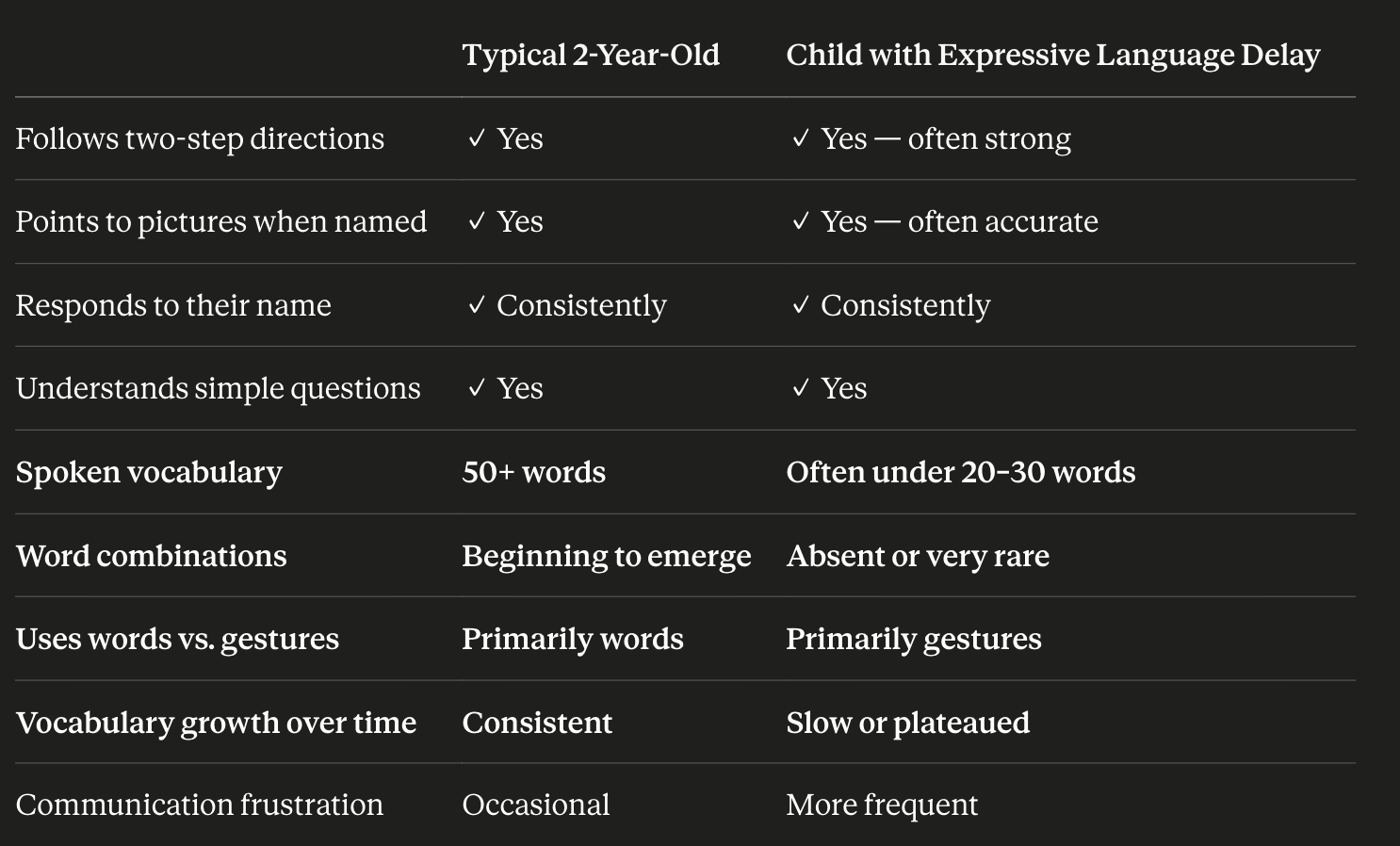
Notice the pattern: the top four rows all the comprehension behaviors look identical between the two children. A parent watching their child respond correctly, follow directions, and point to pictures accurately will naturally feel reassured. The child seems to understand everything. How could there be a problem?
The difference only becomes visible in the bottom five rows in what the child is producing. Fewer words. No combinations. Pointing instead of speaking. Vocabulary that is not growing.
This is why "but they understand everything" is a reassuring sign but not a complete one. A child can have a strong receptive system and a delayed expressive system at the same time. The evaluation separates the two clearly and that separation is what determines what kind of support, if any, is most helpful.
Learn more at: What Causes a Speech Delay, Signs, Causes & When to Get Help?
What Causes a Gap Between Understanding and Talking?
When a toddler understands language well but produces significantly less than expected, several different underlying factors may be contributing:
Expressive Language Delay
The most common explanation. A child with an expressive language delay has intact comprehension and social communication but lags in producing vocabulary and word combinations. The cause is often not identifiable as a single factor it reflects the complex interaction of genetics, language exposure, neurological development, and individual variation in how language skills emerge.
Childhood Apraxia of Speech (CAS)
A motor speech disorder in which the child has difficulty planning and coordinating the movements required to produce speech, even when they know what they want to say. Children with CAS may have a large internal vocabulary (they understand words and may know many) but have significant difficulty getting those words out clearly and consistently. CAS is often characterized by highly inconsistent errors the same word produced differently on different attempts and by more difficulty with longer, more complex words.
Developmental Language Disorder (DLD)
A persistent difficulty with learning and using language that is not explained by hearing loss, neurological conditions, or other developmental differences. DLD can affect expressive language specifically or both expressive and receptive language. Some children with DLD have strong enough receptive skills that the expressive deficit is the primary presenting concern in early childhood.
Hearing Loss
Even mild or intermittent hearing loss including that caused by recurrent ear infections and fluid in the middle ear (otitis media with effusion) can affect speech and language development. A child with hearing loss may understand language reasonably well in quiet, face-to-face interactions (where they can use lip reading and context) but have reduced input overall, contributing to expressive language lag. Hearing evaluation should be part of any speech or language workup.
Autism Spectrum Disorder
Some autistic children have strong receptive vocabulary but show broader social communication differences limited eye contact, limited pointing to share interest, limited joint attention, limited back and forth social engagement alongside limited expressive language. The presentation of strong comprehension with limited speech can occur in autism, though autism involves more than language; the social communication differences are the defining feature. When late talking co-occurs with any social communication differences, an autism evaluation is appropriate alongside speech-language assessment.
Selective Mutism
A less common possibility: selective mutism is an anxiety-based condition in which a child who speaks normally in some settings (typically at home) is unable to speak in other settings (typically outside the home, in public, or with unfamiliar people). A child with selective mutism may appear to "understand everything but not talk" in clinical or unfamiliar settings while speaking typically at home. Parent report of the child's speech in the home environment is essential in distinguishing this from an expressive language delay.
Signs That Suggest More Than Typical Variation
Even with strong comprehension, the following signs indicate that a speech-language evaluation is warranted:
Fewer than 50 words at 24 months The vocabulary benchmark at age 2 is approximately 50 words. A child meaningfully below this threshold particularly one with fewer than 20–30 words has an expressive vocabulary that falls outside the typical range.
No spontaneous two-word combinations by 24 months Word combinations two distinct words combined to create meaning are a critical developmental step. A child who has not begun combining words by 24 months is missing a milestone that signals the beginning of grammatical development.
No consistent vocabulary growth over 4–6 weeks Vocabulary development during the toddler years should be moving forward continuously. A child who has not added new words in several weeks or whose vocabulary seems to have plateaued is showing a pattern that warrants attention regardless of their current word count.
Primarily communicating through gestures at 24+ months Gestures are important and appropriate at 12–18 months. A 2-year-old who is still communicating primarily by pointing, pulling, and gesturing rather than using words has a profile in which gestures are compensating for limited expressive vocabulary rather than supplementing it.
Communication frustration, tantrums, or behavioral difficulties When a child has more to communicate than their expressive language allows, the gap often manifests behaviorally meltdowns, aggression, shutdown, or extreme frustration in situations where needs cannot be expressed. These behaviors are sometimes treated as behavior problems when their primary driver is a communication gap.
Any loss of words previously used If a child was using words and has stopped, or if their vocabulary now seems smaller than it was a few months ago, this regression is a significant red flag that warrants immediate evaluation not monitoring.
Download Our: Developmental Milestones Checklist
When Is It Late Talking vs. a Speech or Language Delay?
The distinction between a "late talker" a child who will likely catch up and a child with a speech or language delay that warrants intervention is not always clear early on. However, the profiles are distinct enough to provide some guidance:
More Consistent with Late Talking
Strong receptive language comprehension is clearly ahead of expression
Good use of gestures with clear communicative intent
Steady vocabulary growth, even if slower than average
Good social engagement eye contact, joint attention, back-and-forth interaction
No loss of previously acquired skills
No family history of persistent language or learning difficulties
More Concerning for a Speech or Language Delay
Vocabulary plateau not adding new words consistently over several weeks
No word combinations emerging by 24 months
Primarily gestures with minimal word attempts, even in highly motivating situations
Communication frustration that is increasing, not decreasing
Limited social communication alongside limited speech
Family history of language delay, reading difficulties, or learning disabilities
Any regression in previously acquired words or skills
Important: This distinction is a clinical judgment, not a parent checklist. The purpose of a speech-language evaluation is precisely to make this determination with standardized tools and clinical expertise not to have parents diagnose the category themselves.
Will they catch up, or is it time to act? Read Late Talkers: Do They Catch Up or Is It a Speech Delay?
Why Strong Understanding Doesn't Guarantee Catch-Up
This is the most important misconception to address directly: a child with strong comprehension will not automatically catch up in expressive language without support.
Research on late-talking children shows that:
Approximately 30–50% of late talkers including many with strong receptive language do not catch up fully by school age without intervention
Children with strong receptive language who receive early speech-language support catch up faster and more completely than those who wait
Even children who "would have caught up anyway" show advantages in language complexity, literacy, and communication confidence when they received early support
Strong receptive language improves the prognosis for catch up. It does not eliminate the need for evaluation, and it does not guarantee that expressive language will develop without targeted support.
The clinical recommendation is the same whether receptive language is strong or not: if expressive language is significantly behind at age 2 and not making clear progress, an evaluation is appropriate not because the outcome is necessarily poor, but because early support during this developmental window is maximally effective.
Speech delay or simply a slower pace? Read Speech Delay vs. Normal Variation: When Should Parents Worry?
What to Expect from a Speech-Language Evaluation
A speech language evaluation for a 2 year old typically takes 60–90 minutes and is conducted in a play based, child friendly format. Parents participate throughout. The evaluation typically includes:
Parent Interview
The speech-language pathologist (SLP) will ask detailed questions about your child's developmental history, communication at home, medical history, family history, and your specific concerns. What you observe at home across all contexts and routines is clinical data that a brief evaluation session cannot replicate.
Standardized Language Assessments
The SLP will use standardized tools to measure expressive and receptive language relative to age norms. Commonly used assessments include:
Preschool Language Scales, 5th Edition (PLS-5) measures both auditory comprehension and expressive communication
Rossetti Infant-Toddler Language Scale assesses interaction, pragmatics, gesture, play, language comprehension, and language expression in children from birth to 3 years
Receptive-Expressive Emergent Language Test, 4th Edition (REEL-4) assesses receptive and expressive language in early childhood
Parent Vocabulary Report
Tools such as the MacArthur Bates Communicative Development Inventories (CDI) ask parents to identify words and phrases from a comprehensive standardized list. This captures the child's full vocabulary as it is observed at home far more representative than what a child produces in a clinical setting.
Observation of Spontaneous Communication
The SLP will observe how your child communicates during play word use, word combinations, gesture use, eye contact, social engagement, play quality, and back-and-forth interaction. This naturalistic observation provides context that standardized scores alone cannot.
Hearing Screening or Referral
Any evaluation for speech or language concerns should include assessment of hearing. If hearing has not been recently evaluated, the SLP may conduct a screening or refer to an audiologist.
What Happens After the Evaluation
If an expressive language delay is identified, recommendations typically include speech-language therapy, Early Intervention services (for children under 3), parent-implemented language strategies, or a combination. If the evaluation does not identify a delay, the SLP may recommend monitoring with specific milestones to watch for and a follow-up timeline.
How to Support Expressive Language Development at Home
Whether or not your child is receiving formal speech-language support, these strategies are evidence-informed and appropriate for all 2-year-olds and particularly helpful for children with expressive language delays.
Model language at your child's level, then one step ahead. If your child is using single words, model two-word combinations frequently. If they are starting to combine two words, model three-word phrases. Research on language input shows that children learn most efficiently from language that is slightly ahead of their current level not significantly above it.
Narrate everything. Talk through what you are doing, what your child is doing, and what is happening around you in simple, clear sentences. "We're washing hands. Water is warm. Soap goes on." This builds vocabulary in the context of real, meaningful daily routines.
Respond to all communication attempts. When your child points, vocalizes, gestures, or attempts a word, respond immediately and warmly. Consistent responsiveness tells the child that their communication works and that it is worth the effort to communicate.
Expand what they say. When your child says "ball," respond with "Yes, a big red ball. It's bouncing." When they say "more," respond with "You want more crackers. Here are more crackers." This technique called expansion and extension models the next step in language development without correcting or pressuring.
Reduce questions, increase comments. Testing your child with "What's that?" and "What color is it?" creates a low-success communication environment. Instead, comment alongside them: "Oh, a truck. It's loud. It's going fast." This reduces performance pressure and models richer language naturally.
Create communication opportunities. Pause before giving your child what they want. Hold up two options and wait. Create moments where your child is motivated to communicate rather than having needs anticipated and met before they have the chance to ask. These natural communication temptations are one of the most effective low pressure ways to elicit language.
Pause and wait. After creating a communication opportunity or asking a question, give your child 5–10 full seconds to respond longer than feels comfortable. This space for initiation is one of the simplest and most evidence-supported language facilitation strategies available.
Read together daily. Picture books, especially those with repetitive text and clear illustrations, build vocabulary, narrative skills, and language exposure. Interactive reading where your child can point, label, and engage is more beneficial than passive listening.
Common Misconceptions
"If she understands everything, her speech will catch up on its own."
Understanding language is a positive prognostic sign but not a guarantee. Research shows that 30–50% of late talkers with strong comprehension do not fully catch up without support. Strong receptive language improves the odds; it does not eliminate the need for evaluation or intervention.
"He's just a late talker boys develop later."
Male sex is a modest risk factor for late talking, not a protective explanation for it. Boys and girls are evaluated against the same developmental milestones. A boy who is significantly behind on expressive language at 24 months and not making progress warrants evaluation with the same urgency as a girl with the same profile. Gender is not a reason to delay.
"She points to everything and seems to understand that's communication enough."
Pointing and gesturing are appropriate and developmentally important, but they are a bridge to spoken language, not a substitute for it. A 2 year-old who is primarily communicating through pointing and gestures rather than words is showing a profile where gestures are compensating for limited expressive vocabulary. This warrants evaluation, not reassurance.
"He'll have a language explosion soon some kids just have that."
Some children do experience a rapid vocabulary growth period sometimes called a word spurt after a period of slower accumulation. But "waiting for the explosion" is not a clinical strategy when a child has been at a plateau for several months. A vocabulary spurt that is coming eventually is not improved by waiting; and if it is not coming, waiting has cost developmental time.
Could growing up with two languages explain the delay? Read Bilingual Child Development: What's Normal and What's Not.
Two is still so young it's too early to worry.
Age 2 is not too early to evaluate. It is, clinically speaking, one of the most important windows for speech language evaluation and intervention. Brain plasticity is highest in the first three years of life. Early Intervention services are specifically designed for children under 3 because the developmental return on investment is highest at this age. Waiting until 3 or 4 to evaluate is not conservative it is costly.
"Getting an evaluation will stress her out."
Speech language evaluations for toddlers are play based and child directed. They are designed to feel like interactive play time, not testing. Most 2 year olds have no distress response to an evaluation. The stress of an evaluation, if any, is negligible compared to the stress of a child who cannot communicate their needs and does not have support.
"Our pediatrician isn't worried, so we shouldn't be either."
Pediatricians conduct developmental surveillance across a wide range of domains in brief well child visits. They are not speech language specialists. Developmental screening tools used at well child visits have known false negative rates they miss some children who do have delays. A parent who remains concerned after a reassuring pediatrician visit has every right to seek an independent evaluation, and that concern is clinically meaningful.
When Should Parents Seek a Speech-Language Evaluation?
Seek evaluation now if your 2-year-old:
Has fewer than 50 words at 24 months
Is not combining two words spontaneously
Has not added new words in the past several weeks
Is primarily communicating through gestures rather than words
Shows increasing frustration around communication
Has lost any words they were previously using
Seek evaluation promptly if your child:
Has strong comprehension but expressive vocabulary significantly below expectations
Has a family history of language delay, reading difficulties, or learning disabilities
Was born premature language milestones should be assessed at corrected age
Has recurrent ear infections or a history of ear fluid (otitis media)
Do not wait if:
Your gut tells you something is different, even if you can't articulate exactly what
Your pediatrician is reassuring but you remain concerned seek an independent evaluation
Your child has lost any skills they previously demonstrated
For children under 3, contact your state's Early Intervention program directly. No referral is required. Evaluations are available at no cost under federal law (IDEA Part C).
Frequently Asked Questions
Why does my child understand everything but not talk?
A toddler who understands language well but produces significantly fewer words than expected most likely has an expressive language delay a gap between receptive language (comprehension) and expressive language (speaking). These are separate developmental skills that can develop at different rates. Strong comprehension is a positive sign but does not guarantee that expressive language will develop on its own. A speech language evaluation can clarify the profile and determine whether support is needed.
Is it normal for a 2 year old not to talk but understand everything?
By age 2, most children are using at least 50 words and beginning to combine them. A child who understands language well but has significantly fewer than 50 words, is not combining words, or has not added new vocabulary in several weeks has a profile that warrants a speech language evaluation. Some degree of receptive expressive gap is typical, but a large and persistent gap is not and is exactly what speech language evaluation is designed to assess.
Can a child understand everything and still have a speech delay?
Yes. Receptive language (understanding) and expressive language (speaking) are distinct skills that can develop at different rates. A child with strong comprehension can still have a meaningful expressive language delay. In fact, this pattern strong understanding with limited expressive output is the most common profile among toddlers who are late talkers. Strong comprehension improves the prognosis for catch up but does not eliminate the need for evaluation or support.
What is expressive language delay?
Expressive language delay is a condition in which a child's ability to produce words, phrases, and sentences develops more slowly than expected for their age, while their ability to understand language remains relatively intact. In a 2 year old, it typically presents as a vocabulary below 50 words, absence of two-word combinations, or limited vocabulary growth over time despite clear evidence of understanding. Expressive language delay is the most common cause of late talking in otherwise typically developing toddlers and responds well to early speech-language intervention.
Could my child's limited talking be a sign of autism?
Some autistic children present with strong receptive vocabulary but limited expressive language so autism is in the differential when a child understands well but isn't talking. However, autism involves broader social communication differences beyond expressive vocabulary: limited eye contact, limited pointing to share interest, limited social reciprocity, and limited joint attention. A child who has strong social engagement, typical eye contact, good use of gestures to share interest, and responsive social interaction but limited expressive vocabulary has a profile that is more consistent with expressive language delay than autism. If there are any social communication concerns alongside limited speech, an evaluation that specifically addresses autism spectrum disorder is appropriate.
How do I get my child evaluated for a speech delay?
For children under 3, contact your state's Early Intervention program directly no physician referral is required, and evaluations are available at no cost under federal law (IDEA Part C). You can also ask your pediatrician for a referral to a speech-language pathologist, or seek a private evaluation through a pediatric SLP directly. Aldea can help you find a qualified speech language pathologist in your area.
What happens in a speech-language evaluation for a 2-year-old?
A speech language evaluation for a toddler is play based and parent inclusive. The speech-language pathologist will conduct a parent interview, use standardized language assessments (such as the PLS-5 or Rossetti scale), review a parent vocabulary report, and observe the child during naturalistic play. The full evaluation typically takes 60–90 minutes. Results and recommendations are typically provided at the end of the session or within 1–2 weeks. If a delay is identified, the evaluator will recommend the appropriate type and intensity of support.
Should I use sign language with my late-talking toddler?
Yes, teaching simple signs to a late talking toddler does not delay speech development. Research consistently shows that signing supports communication, reduces frustration, and does not compete with spoken language development. Many children use signs as a bridge to spoken words using the sign while attempting the word, then dropping the sign when the spoken word becomes reliable. If your child's SLP recommends an augmentative strategy, using it will support communication, not slow it down.
My pediatrician said my son will catch up because boys talk later. Should I wait?
Male sex is a mild risk factor for late talking, not a developmental exemption. Boys are evaluated against the same developmental milestones as girls. If your son is at 24 months with fewer than 50 words, not combining words, and not making clear progress, that profile warrants evaluation regardless of gender. You can contact Early Intervention directly without waiting for a referral. Your concern is valid act on it.
How Aldea Can Help
When your child understands everything but isn't talking the way you expect, it can be hard to know whether to act or wait and harder still to find the right person to give you an honest answer.
Aldea helps families find licensed specialists including speech language pathologists, developmental pediatricians, and child psychologists for evaluations, therapy, and developmental support, all in one place.
Aldea connects families with licensed speech-language pathologists and developmental specialists who evaluate and support young children with communication concerns. Whether you are trying to understand whether your child's profile is a typical variation or a delay, looking for an evaluation, navigating Early Intervention, or trying to understand what a diagnosis means, Aldea helps you find the right provider and take the right next step.
You do not need a referral. You do not need a diagnosis. You need a concern and that is enough to start.
Not sure what to watch for next? Explore our free developmental checklists, milestone guides, and screening tools designed to help you track your child's progress with confidence.
Connect with an Aldea speech-language specialist →
Conclusion
A 2 year old who understands everything but isn't talking much most likely has an expressive language delay a gap between strong comprehension and limited spoken output. Strong receptive language is genuinely reassuring and improves the likelihood of catching up. It does not, however, guarantee that expressive language will develop without support, and it is not a reason to delay evaluation.
By age 2, most children use at least 50 words and begin combining them. A child with strong comprehension who is not reaching these benchmarks, who is not adding new words consistently, or who is primarily communicating through gestures has a profile that warrants a speech language evaluation during the developmental window when early support has its greatest impact.
Early Intervention services are available at no cost for children under 3, accessible without a physician referral, and supported by strong evidence for improving language outcomes. If you are uncertain whether your child's speech is on track, that uncertainty itself is worth acting on.
This article was written for informational and educational purposes by Aldea, a developmental and behavioral health navigation platform. It does not constitute medical advice or establish a clinical relationship. If you have concerns about your child's speech or language development, please consult a qualified speech-language pathologist or developmental specialist.
Michelle McGuinness, M.S., CCC SLP
Michelle N. McGuinness, MA, CCC-SLP is a nationally certified speech-language pathologist with 10+ years across schools, clinics, and telehealth, she specializes in autism, language disorders, apraxia, fluency, AAC, and bilingual development. Fluent in English and Spanish, Michelle is trained in PROMPT and the Hanen Program. A Fordham, Lehman, and Columbia University graduate, she is passionate about leveraging technology to expand access to quality pediatric care.